


SonarQube vs Sourcegraph
Side-by-side comparison of features, pricing, ratings, and alternatives.

SonarQube is a static code analysis platform that continuously inspects code quality and security vulnerabilities across many programming languages. It provides automated detection of bugs, code smells, and security hotspots, helping teams maintain clean, maintainable code. The platform integrates with CI/CD pipelines, offers customizable quality gates, and delivers detailed dashboards for developers and managers. It supports both cloud SaaS and self‑hosted deployments, with a free Community edition and paid editions for advanced governance.
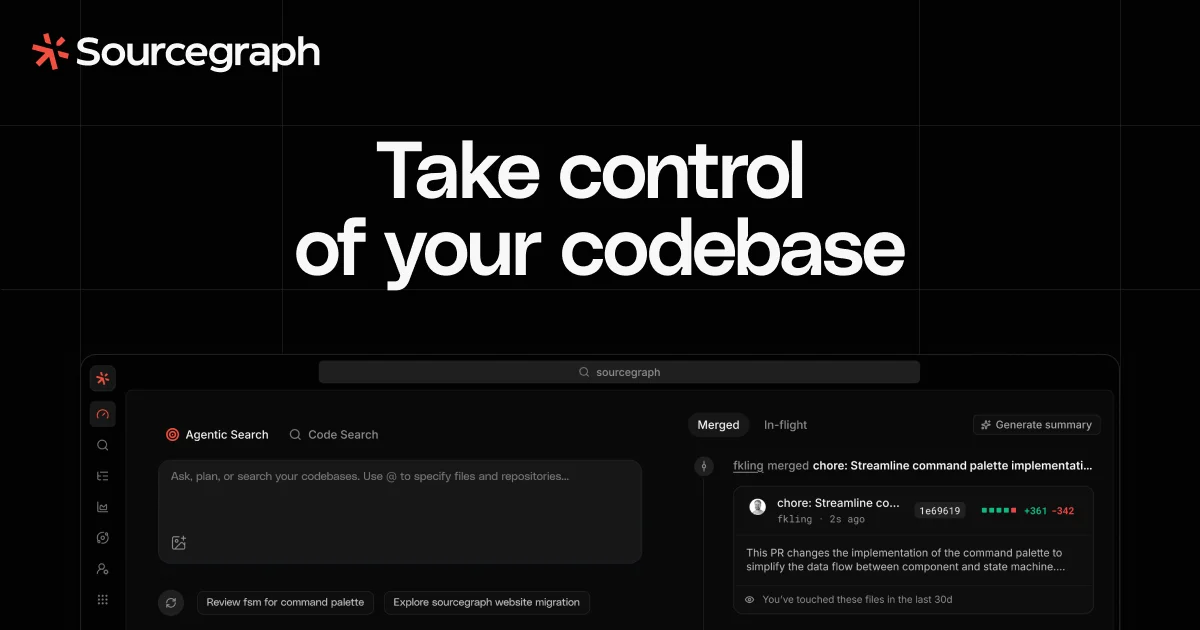
Sourcegraph is a code search and intelligence platform that lets engineering teams search, navigate and understand large codebases across repositories. It provides fast, indexed search, rich code navigation, and contextual insights directly in the developer workflow. The service integrates with GitHub, GitLab, Bitbucket and other version‑control systems, offering both a cloud SaaS offering and a self‑hosted option for enterprises that need on‑prem security and compliance.
- Broad language support
- Deep integration with CI/CD pipelines
- Free Community edition
- Rich, customizable dashboards
- Scales to millions of lines of code with low latency
- Works with any language and VCS
- Rich IDE integrations reduce context switching
- Self‑hosted version satisfies strict compliance needs
- Self‑hosted setup can be complex
- Advanced features require paid license
- Performance may degrade on very large codebases
- Advanced features require paid tier
- Initial setup for self‑hosted can be complex
- UI may feel heavy for very small teams
More alternatives & similar tools
Alternatives to SonarQube
View all →
AI code review platform that triages, reviews and security-scans every pull request.

AI-powered code review platform combining static analysis with automated pull request fixes.
Alternatives to Sourcegraph
View all →
The Verdict
AI-generated from listing dataSourcegraph excels at universal code search and cross‑repo intelligence, while SonarQube focuses on static analysis and quality gates; choose based on whether you need search/intelligence or deep quality/security analysis.
Key differences
- •Primary purpose: Sourcegraph provides code search & navigation; SonarQube provides static analysis & quality gating.
- •Language support: SonarQube lists >25 languages; Sourcegraph works with any language but specific count not given.
- •Integration focus: Sourcegraph embeds in IDEs (VS Code, JetBrains); SonarQube embeds in CI/CD pipelines (Jenkins, GitHub Actions).
- •Deployment emphasis: Sourcegraph highlights self‑hosted Docker/K8s for data sovereignty; SonarQube also self‑hosts but notes complex setup.
- •Analytics vs. issue reporting: Sourcegraph offers code health analytics; SonarQube provides detailed issue reports and security hotspots.
Pricing & value
Both offer freemium models with paid tiers for advanced features; no price details provided.
Ease of use / learning curve
Sourcegraph integrates directly into IDEs, reducing context switching; SonarQube requires CI/CD configuration.
Features & depth
SonarQube provides extensive static analysis, quality gates, and security hotspot remediation.
Integrations & ecosystem
Both support major VCS and CI/CD tools; Sourcegraph adds IDE extensions, SonarQube adds CI/CD plugins.
Collaboration
Sourcegraph offers granular access controls, SSO, and shared code navigation across teams.
Scalability
Sourcegraph claims low‑latency search across millions of lines of code; SonarQube notes performance may degrade on very large bases.
Support & security
Both provide community forums, email, and paid enterprise support; both are open source.
Choose SonarQube if…
Teams prioritizing automated code quality, security analysis, and CI/CD gating.
Choose Sourcegraph if…
Teams needing fast, cross‑repo code search and IDE‑centric collaboration.
Common questions
Can either tool be self‑hosted for compliance?
Yes; both offer self‑hosted deployments (Sourcegraph via Docker/Kubernetes, SonarQube via on‑premise install).
Which tool integrates directly into my IDE?
Sourcegraph provides native extensions for VS Code and JetBrains IDEs; SonarQube integrates via CI/CD pipelines, not IDEs.
Do both support the same programming languages?
SonarQube explicitly supports over 25 languages; Sourcegraph works with any language but specific count isn’t listed.