


The House of the Dead vs The House of the Dead: Overkill
Side-by-side comparison of features, pricing, ratings, and alternatives.
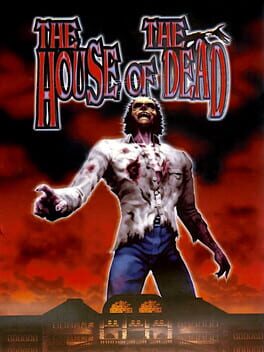
The House of the Dead is a first‑person light‑gun arcade shooter where agents Thomas Rogan and "G" battle the twisted creations of mad biochemist Dr. Roy Curien. Set in the eerie Curien Mansion, players blast through hordes of undead and monstrous bosses while racing to rescue Rogan’s fiancée, Sophie Richards.\n\nOriginally released in 1996, the game features both single‑player and cooperative multiplayer modes, delivering fast‑paced horror action with a sci‑fi twist. Its iconic boss encounters, such as The Chariot and The Magician, have made it a lasting classic in arcade horror gaming.
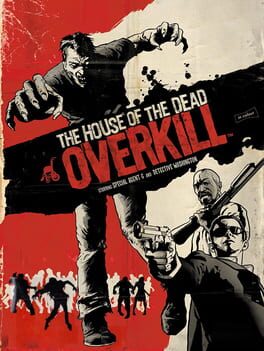
The House of the Dead: Overkill is a fast‑paced rail shooter set in 1991 Louisiana, where agents battle mutants and a deranged crime boss. Players wield a Wii Remote‑style reticle, using Danger Cam to peek around corners while blasting hordes of enemies. The game supports solo play or two‑player co‑op, offering single‑weapon or dual‑wielding control schemes, and blends horror, action, and dark comedy for a mature audience.
- Classic light‑gun mechanics
- Engaging cooperative mode
- Memorable boss designs
- Atmospheric horror setting
- Exciting rail shooter mechanics
- Innovative Danger Cam system
- Entertaining co‑op mode
- Strong horror‑comedy vibe
- Limited modern graphics
- Requires compatible light‑gun hardware
- Linear level design can feel repetitive
- Limited to pre‑determined movement
- Requires motion controller for full experience
- No online multiplayer
More alternatives & similar tools
Alternatives to The House of the Dead
View all →
Alternatives to The House of the Dead: Overkill
View all →
Classic light‑gun horror shooters revived with Wii Zapper support and new Extreme mode
The Verdict
AI-generated from listing dataThe House of the Dead (A) offers classic free‑aim light‑gun arcade action, while The House of the Dead: Overkill (B) delivers a rail‑shooter with horror‑comedy flair and score‑driven competition.
Key differences
- •A uses free‑aim light‑gun shooting; B uses a motion‑controlled rail shooter with predetermined movement.
- •A includes a journal system revealing boss weak points; B adds a Danger Cam for peeking around edges.
- •B provides voice‑acted characters and horror‑comedy tone; A focuses on atmospheric horror without comedy.
- •B lists a concrete MSRP ($59.99) and critic score (82/100); A’s price is not specified.
- •B lacks online multiplayer but offers score multipliers for competitive play; A has no such scoring system.
Gameplay & fun factor
A gives free‑aim light‑gun control, offering more shooting freedom than B’s fixed‑path rail shooter.
Platform availability
Neither product lists specific platforms; availability cannot be compared from the given facts.
Price & value
A’s price is not specified; B costs $59.99, so a direct value comparison isn’t possible.
Multiplayer / co‑op
Both support two‑player local co‑op; A needs a light‑gun, B needs a motion controller.
Content & replayability
A offers boss weak‑point journals; B adds score multipliers and Danger Cam, making replay value roughly even.
Difficulty & accessibility
Both require special hardware (light‑gun or motion controller), limiting accessibility equally.
Graphics & performance
B, released in 2009, likely has more modern graphics than A’s 1996 visuals.
Choose The House of the Dead if…
Buyers who own a compatible light‑gun and prefer classic free‑aim arcade shooting with cooperative boss battles.
Choose The House of the Dead: Overkill if…
Buyers who have a motion controller, enjoy rail‑shooter pacing, horror‑comedy tone, and competitive scoring.
Common questions
What is the price of The House of the Dead (A)?
The price is not specified in the provided information.
Do I need special hardware to play either game?
Yes. A requires a compatible light‑gun; B works best with a motion controller for full features.
Is online multiplayer available?
No. Both titles only support local multiplayer/co‑op; B explicitly notes no online multiplayer.