


Tron vs Tron: Solar Sailer
Side-by-side comparison of features, pricing, ratings, and alternatives.
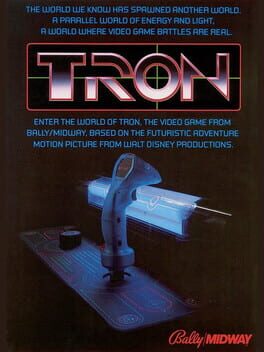
Tron is a 1982 coin‑operated arcade game by Bally Midway, inspired by Disney's groundbreaking film. It features four distinct subgames that let players pilot Light Cycles, fight with battle tanks, and defend the Input/Output Tower. Designed for both solo and multiplayer action, Tron blends shooter, strategy, and arcade thrills with a futuristic aesthetic, delivering a nostalgic yet challenging experience for gamers of all ages.
Tron: Solar Sailer is a classic arcade-style game that puts you behind the controls of a futuristic lightcraft, navigating treacherous grids inspired by the 1982 Disney film TRON. Developed and published by Mattel Electronics, the game was released for the Intellivision console at the end of 1983. The single-player experience challenges you to avoid obstacles, outmaneuver enemy programs, and complete missions across a series of increasingly difficult levels. Its sci‑fi aesthetic and fast‑paced action capture the spirit of the original movie while delivering a nostalgic gaming experience.
- Authentic recreation of the 1982 arcade experience.
- Variety of gameplay modes keeps sessions fresh.
- Multiplayer support encourages social play.
- Distinct visual style true to the original film.
- Authentic retro graphics and sound
- Challenging single-player gameplay
- Faithful to the TRON aesthetic
- Simple controls with deep skill ceiling
- Limited to retro graphics and sound, may feel dated.
- High difficulty curve for newcomers.
- No modern online features or updates.
- Limited to one platform (Intellivision)
- No multiplayer options
- Lacks modern save features
More alternatives & similar tools
Alternatives to Tron
View all →
Create programs, pilot vehicles and fight in Tron’s digital arena
Alternatives to Tron: Solar Sailer
View all →
Create programs, pilot vehicles and fight in Tron’s digital arena
The Verdict
AI-generated from listing dataProduct B provides broader gameplay variety and multiplayer support, while Product A is a single‑player, Intellivision‑only experience with a narrower focus.
Key differences
- •Platform: A runs only on Intellivision; B runs on original 1982 arcade hardware (implied broader compatibility).
- •Multiplayer: A is single‑player only; B supports both single‑player and multiplayer.
- •Content variety: A offers ten stages of a single light‑craft mode; B includes four distinct subgames (light cycles, tanks, I/O Tower, etc.).
- •Replayability features: A relies on high‑score tables; B adds multiple game modes and competitive play.
- •Developer/publisher pedigree: A by Mattel Electronics; B by Bally Midway and Disney‑linked publishers.
Gameplay & fun factor
B offers four distinct subgames and multiplayer, giving more varied fun than A's single light‑craft mode.
Platform availability
B runs on original arcade hardware, a broader platform than A's single Intellivision release.
Price & value
Both are paid one‑time purchases; no price details provided to differentiate value.
Multiplayer / co‑op
B supports both single‑player and multiplayer; A is single‑player only.
Content & replayability
B's multiple subgames and multiplayer increase replay value versus A's ten stages and high‑score table.
Difficulty & accessibility
A’s simple joystick/button controls and single mode may be more accessible than B’s higher difficulty curve.
Graphics & performance
Both feature authentic 1980s retro graphics and sound; no superiority indicated.
Choose Tron if…
Players seeking varied arcade experiences, multiplayer competition, and broader platform support.
Choose Tron: Solar Sailer if…
Solo retro enthusiasts who own an Intellivision and want a focused single‑player light‑craft challenge.
Common questions
Can I play either game on modern consoles or PC?
Not specified for either; A is limited to Intellivision, B runs on original 1982 arcade hardware.
Does either game support multiplayer?
Product B supports both single‑player and multiplayer; Product A is single‑player only.
Which game offers more content to keep me playing?
Product B includes four distinct subgames and multiplayer modes, while Product A offers ten stages of a single mode.