


BGPT (BioGPT)
An evidence layer for scientific AI that presents every claim with its evidence, limitations, and scope.
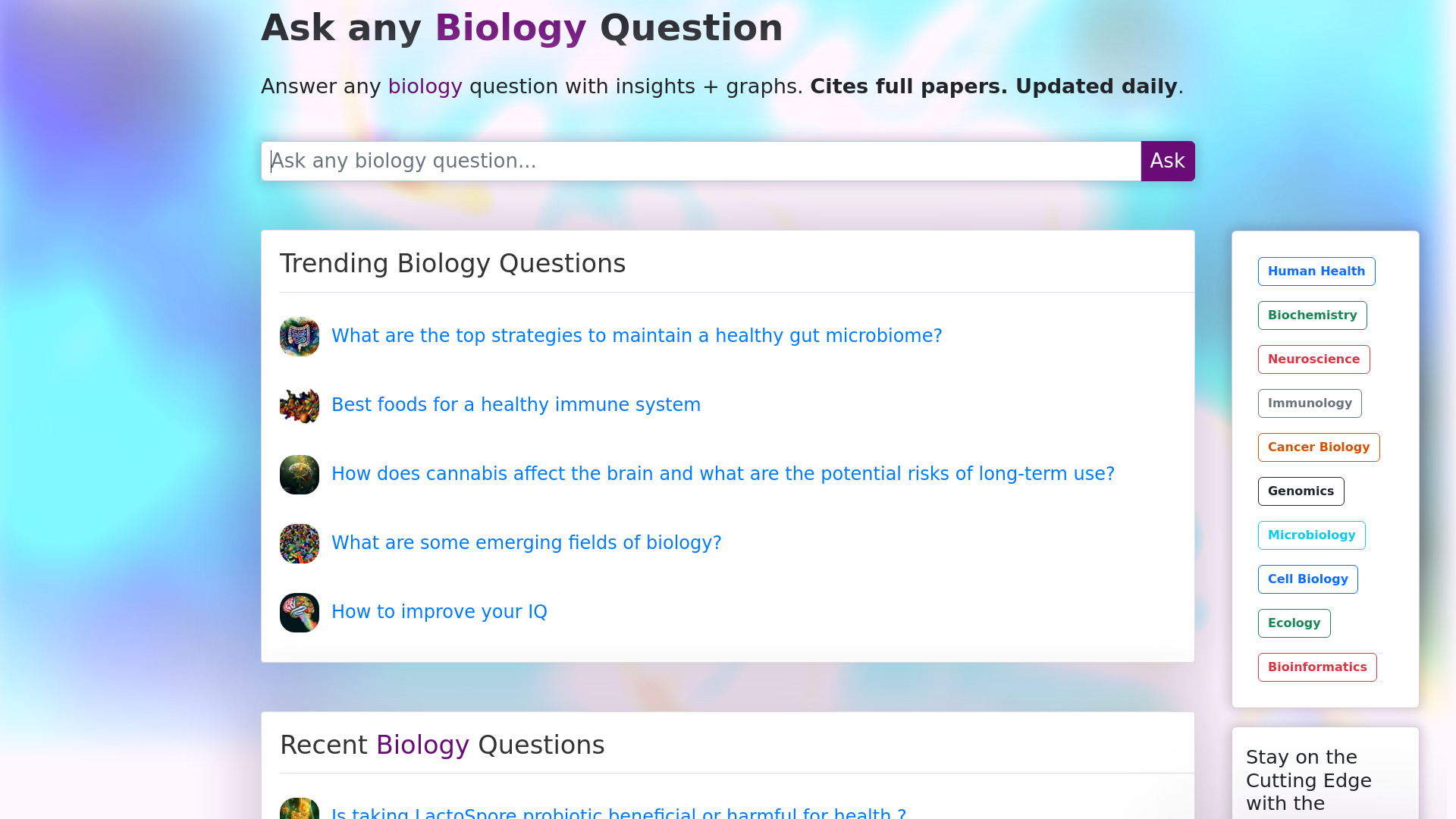
What is BGPT (BioGPT)?
BGPT is an evidence layer for scientific AI, designed to present scientific claims with supporting evidence, scope, and limitations instead of unsupported assertions. It operates as both a web resource and an MCP (Model Context Protocol) integration, making evidence-qualified scientific statements available to tools like Claude, Cursor, and other compatible AI assistants. Each claim is paired with one evidence-qualified sentence and linked to a full evidence page for deeper verification. The homepage organizes current evidence into six scientific domains: microbiome and infectious disease, genomics/evolution/development, neuroscience/behavior, human health/medicine, AI methods/biosecurity, and ecology/origins of life. Example claims span topics from jellyfish sleep regulation and urolithin A longevity to avian song complexity and LLM-assisted systematic reviews. Rather than merely presenting findings, BGPT scores papers for quality, novelty, and reproducibility, and explicitly states limitations next to each conclusion. This makes BGPT useful for researchers, clinicians, students, and anyone relying on AI-generated or rapidly summarized scientific information. Its emphasis on completeness and caution—acknowledging when evidence is mechanistic, underpowered, or model-derived—helps reduce over-citation and scientific misinformation. The service is particularly relevant for professionals working with AI assistants who need source-grounded, limitation-aware evidence.
SpecificationsAI-estimated
Key Features of BGPT (BioGPT)
Use Cases for BGPT (BioGPT)
Citing scientific claims safely
Use BGPT to find evidence-qualified statements and limitations before adding findings to research papers or documents.
Reviewing paper quality signals
Quickly check per-paper scores for quality, novelty, and reproducibility when evaluating a study.
Querying evidence in AI assistants
Connect BGPT via MCP to Claude, Cursor, or compatible tools to ground AI responses in scientific evidence.
Researching health and medicine claims
Explore topics such as urolithin A and longevity, UV and skin cancer, or pesticide neurotoxicity with explicit caveats.
Exploring genomics and evolution evidence
Investigate regulatory evolution, cell-type diversification, flagellar motility, and related research.
Teaching critical evaluation of science
Use the claim-plus-limitations format to show how conclusions should be scoped in education or science communication.
Assessing AI and biosecurity literature
Review evidence around LLM-based systematic reviews and other AI/methods claims with transparency.
Checking ecology and origins-of-life hypotheses
Examine avian song complexity, bat echolocation, binary-star exoplanet survival, and autopoiesis-related findings.
How to use BGPT (BioGPT)?
Browse the evidence layer
Visit biologpt.com and scan scientific claims organized by domain such as medicine, genomics, or ecology.
Open a full evidence page
Click any claim link to review the complete BGPT evidence entry, including supporting details and linked sources.
Assess evidence quality
Review scores for quality, novelty, and reproducibility, and pay attention to the limitations and scope stated alongside each finding.
Integrate with AI tools via MCP
Connect BGPT to Claude, Cursor, or compatible MCP clients to retrieve evidence-qualified claims directly inside your AI workflow.
Verify before using
Use the linked evidence pages to confirm context, limitations, and reproducibility when citing or acting on a scientific claim.
Pros & Cons of BGPT (BioGPT)
Pros
- Explicitly states limitations and scope for each scientific claim
- Scores papers on quality, novelty, and reproducibility
- Integrates with AI tools via MCP for Claude, Cursor, and compatible assistants
- Covers a broad range of scientific domains from medicine to evolutionary biology
- Links every claim to a full evidence page for verification
Cons
- Evidence base appears curated rather than exhaustive across all scientific literature.
- No native mobile or desktop app is mentioned.
- MCP integration requires a compatible AI assistant and setup.
- Homepage does not detail the paper-selection or scoring methodology.
Frequently Asked Questions
What is BGPT?
BGPT is an evidence layer for scientific AI. It presents scientific claims with supporting evidence, scope, limitations, and per-paper scores, available via the web and MCP for tools like Claude and Cursor.
How does BGPT present evidence?
Each claim carries one evidence-qualified sentence, never overstated, with quality, novelty, and reproducibility scored per paper. Limitations and scope are stated alongside findings, and every item links to a full BGPT evidence page.
Which tools can I use BGPT with?
BGPT is available as a website and through MCP, allowing integration with Claude, Cursor, and other compatible AI tools.
What scientific areas does BGPT cover?
The homepage covers microbiome and infectious disease, genomics/evolution/development, neuroscience/behavior, human health/medicine, AI methods and biosecurity, and ecology/origins of life.
Does BGPT claim that findings are proven?
No. BGPT emphasizes evidence-qualified statements and limitations. For example, urolithin A and human longevity is described as biologically plausible but unproven, with no randomized human trial showing survival benefit.
Is BGPT open source?
The homepage does not state an open-source license, so its open-source status is unknown from the available content.
Does BGPT provide original experimental data?
No. BGPT summarizes and evaluates scientific papers; some entries specifically note when a model contains zero primary data or relies on indirect parameters.
How current is the evidence on the homepage?
The homepage was updated September 19, 2026, according to the site content.
Reviews & Ratings0.0
No reviews yet. Be the first to write one!
Top Alternatives & Similar Software
View all alternatives & similar software→No alternatives available yet.
People also viewed



Related searches
About the Product
Is this your tool?
Claim this page to update details, reply to user reviews, and drive more traffic to your product.
Claim this Product →
Tags
Keep up with BGPT (BioGPT) alternatives
New alternatives, pricing changes and the week's biggest movers - one email every Tuesday.