


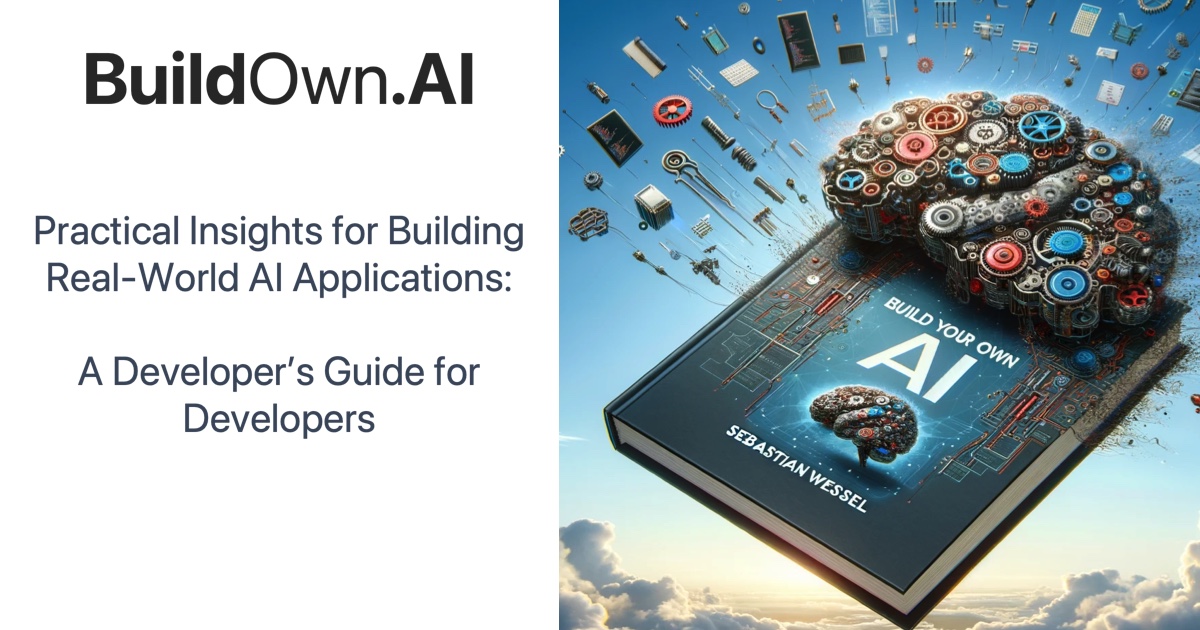
Build Your Own AI
A practical, framework-free developer's guide to building real-world AI applications with large language models.
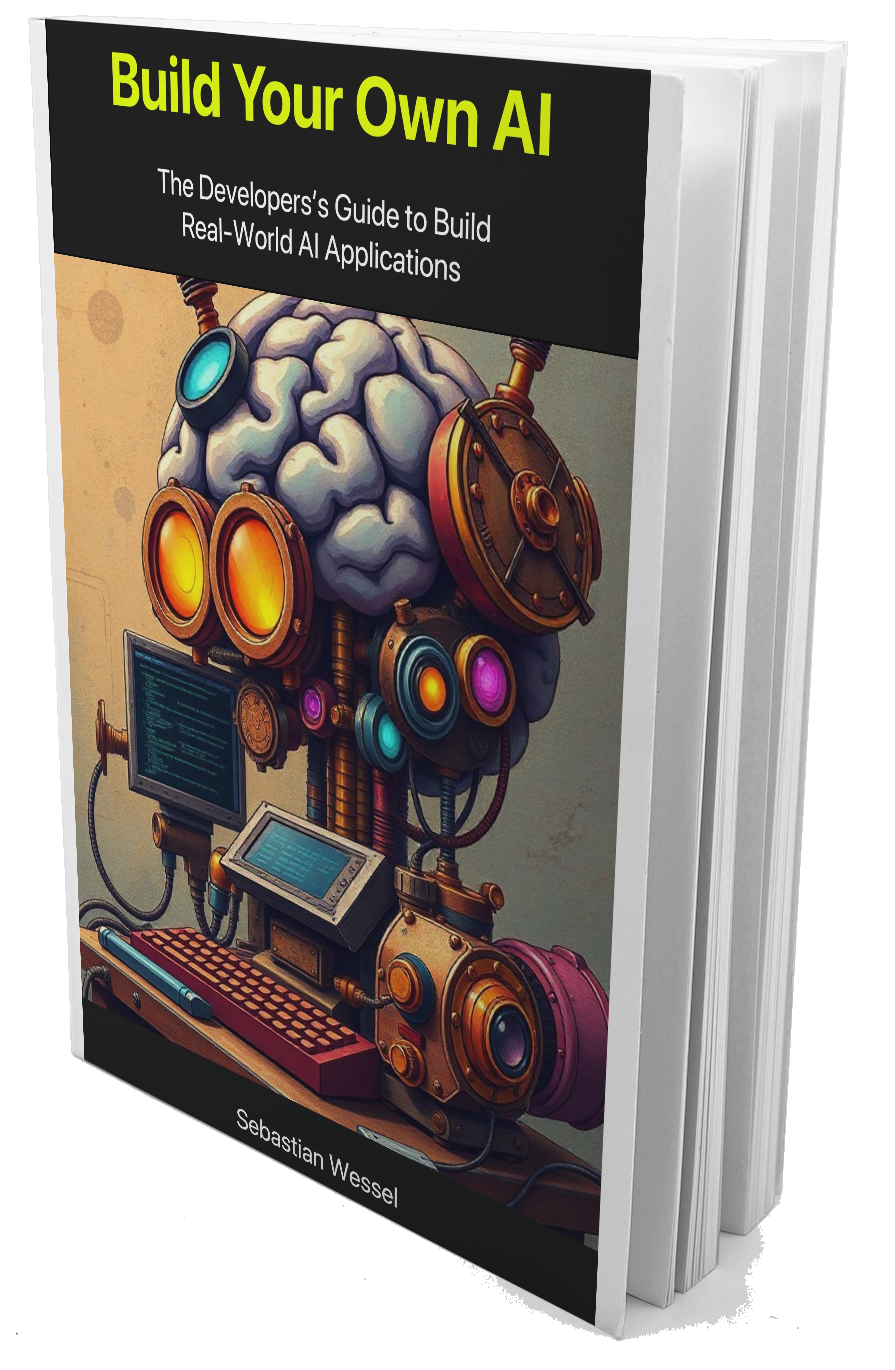



What is Build Your Own AI?
Build Your Own AI is a digital developer guide written by a coder for coders, focused on the practical skills needed to build real-world applications with Large Language Models. Rather than presenting a dense academic treatment, it follows the author's own hands-on learning journey and breaks down core AI concepts into clear, approachable explanations. The result is a structured, no-nonsense path from understanding what LLMs are all the way to building complex agent-based systems.
SpecificationsAI-estimated
Key Features of Build Your Own AI
Use Cases for Build Your Own AI
Getting started with LLMs
Developers with no prior AI experience can build a solid foundation in LLM terminology and core concepts.
Running LLMs locally
Learn how to run models on your own hardware to gain full control, protect privacy, and improve inference performance.
Improving prompt engineering skills
Understand how input phrasing and prompt structure shape model responses for better outputs.
Building RAG applications
Build RAG pipelines that combine vector databases and document retrieval for accurate, context-rich answers.
Adding tool calling to AI apps
Extend an LLM's capabilities by integrating external tools for improved functionality and personalized interactions.
Creating AI agents
Learn how to design multi-step agent scenarios for solving complex, real-world tasks.
Data extraction and creation
Use LLMs for practical data tasks like summarization, translation, extraction, and structured data creation.
Exploring fine-tuning basics
Gain a sneak peek into fine-tuning approaches and what is required to adapt a model for specific tasks.
How to use Build Your Own AI?
Preview the book
Visit the Build Your Own AI website and browse the full book preview with chapter summaries to understand each section.
Buy the book
Purchase the book through the author's online store to get access to the complete guide.
Follow the structured learning path
Read through the chapters in the provided order, starting from basic understanding and moving into advanced topics like RAG, tool calling, and agents.
Practice with pure TypeScript examples
Run the clean TypeScript examples on your own machine. They use pure logic and simple HTTP requests with no frameworks or libraries required.
Apply the knowledge to your stack
Take the universal concepts and patterns you learn and adapt them to your own preferred programming language and real-world AI projects.
Pros & Cons of Build Your Own AI
Pros
- Language-agnostic core concepts make it useful for developers in any programming language.
- No frameworks or libraries required—just pure logic and simple HTTP requests.
- Structured, logical progression from fundamentals to advanced LLM topics.
- Transparent preview lets you see the full chapter breakdown before purchasing.
- Practical, real-world focus authored by a developer rather than a scientist.
Cons
- All code examples are shown in TypeScript, so readers strongly tied to other languages may need to mentally translate the patterns.
- Not designed for data scientists or machine learning researchers seeking a scientific treatment of LLMs.
- Explains universal patterns rather than providing copy-paste playbooks, so developers looking for turnkey recipes may want more concrete examples.
- Only available as a digital product through the author's store; no physical paperback or audiobook is mentioned.
Frequently Asked Questions
Who is this book for?
The book is written for developers, absolute beginners, enthusiasts, and anyone with some existing coding knowledge. It is explicitly not designed for scientists, but instead for people who want to deepen their practical understanding of coding with large language models.
Do I need to learn Python or JavaScript/TypeScript?
No. The book is language-agnostic by design. It focuses on core concepts and patterns that every developer can benefit from, regardless of their preferred programming language. The examples are illustrated in clean TypeScript, but you don't need to learn Python or JavaScript/TypeScript to get value from the material.
Which topics are covered in the book?
The book covers basic LLM understanding, running LLMs locally, prompt engineering, data extraction & creation, RAG (Retrieval-Augmented Generation), tool calling, agents, basics of fine-tuning, and practical tips & tricks for getting the most out of LLMs.
Can I preview the book before purchasing?
Yes. The website allows you to preview the entire book, with each chapter summarized to give you a clear overview of what is covered before you buy.
Does the book require using a specific AI framework or library?
No. The book is framework-free and library-free. It uses pure logic and simple HTTP requests, so there are no abstractions and no hidden functionality to fight against.
Is the book only for Python or JavaScript developers?
The book is for everyone outside the scientific community, regardless of the language you use. The core principles are universal and easily adaptable to any programming language you prefer.
Why should I buy the book if there is free content available?
Because blogs, Python playbooks, and videos are often scattered and time-consuming to organize in the right order. This book provides a structured, comprehensive guide that saves time and presents everything in a clear, logical sequence.
Reviews & Ratings0.0
No reviews yet. Be the first to write one!
Top Alternatives & Similar Software
View all alternatives & similar software→No alternatives available yet.
People also viewed




Related searches
Is this your tool?
Claim this page to update details, reply to user reviews, and drive more traffic to your product.
Claim this Product →
Tags
Explore Related Topics
Keep up with Build Your Own AI alternatives
New alternatives, pricing changes and the week's biggest movers - one email every Tuesday.