



jcode
Open-source terminal AI coding agent built for parallel workflows and resource efficiency.
What is jcode?
An open-source AI coding agent for the terminal, written in Rust and designed for high parallelism, low resource usage, and deep harness-level optimizations. It aims to make running many AI coding agents simultaneously practical on consumer hardware, while keeping the tool fully inspectable and modifiable under an MIT license.
SpecificationsAI-estimated
Key Features of jcode
Use Cases for jcode
Parallel task execution
Spin up multiple coding agents at once to work on different tasks without exhausting memory or waiting for one agent to finish.
Long-running autonomous tasks
Use headless `jcode run` with auto-poke to keep working across turns until a task is actually complete.
Resource-constrained development
Run dozens of sessions on consumer machines thanks to ~10 MB extra memory per additional session.
Model-agnostic optimization
Use the same model with a harness engineered for faster feedback, better memory, and improved pass rates.
How to use jcode?
Install
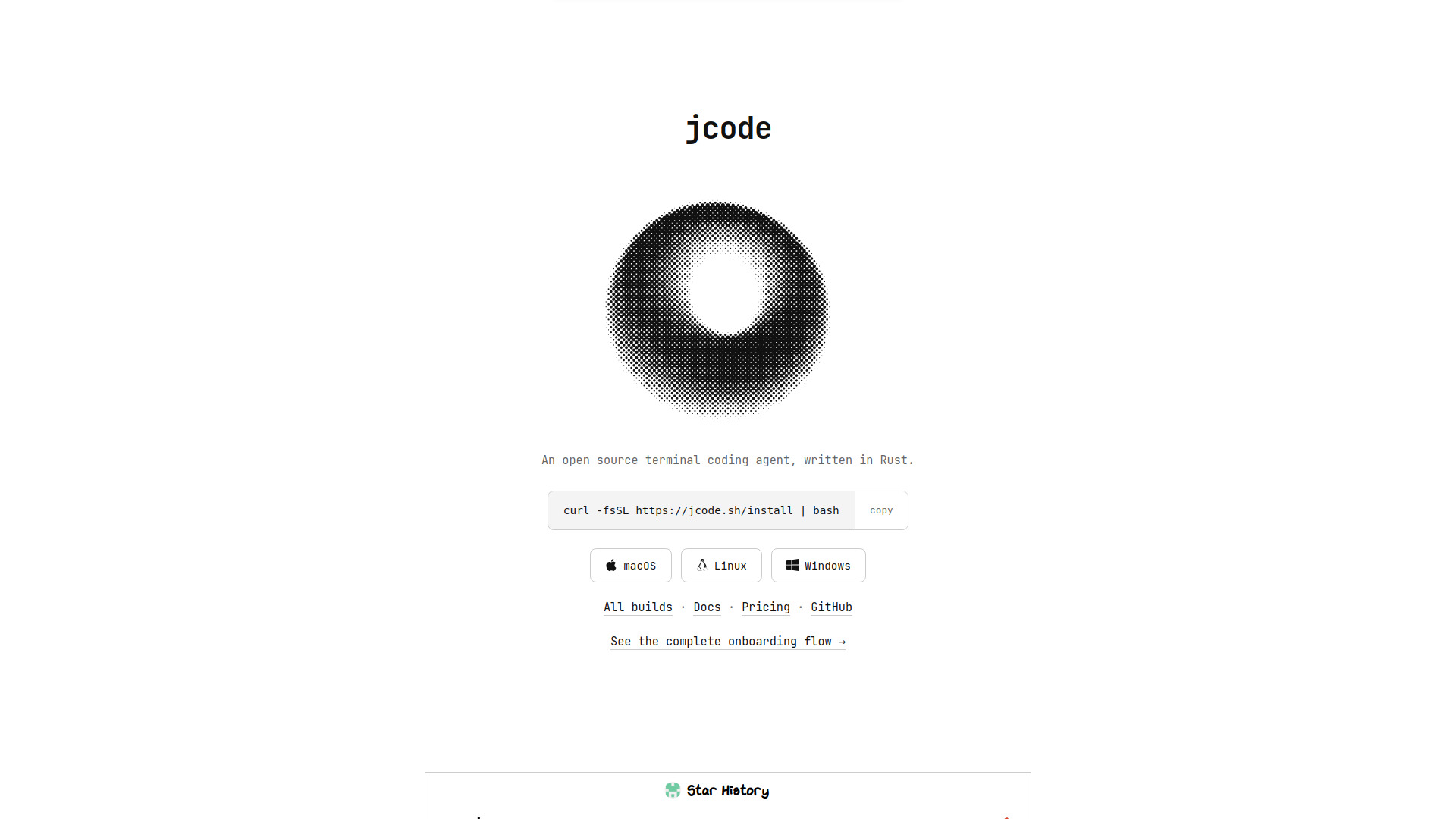
Run `curl -fsSL https://jcode.sh/install | bash`.
Launch interactive TUI
Start jcode in a terminal to spawn an interactive AI coding session.
Spawn parallel agents
Open additional jcode sessions to parallelize work, relying on low memory overhead.
Use background tools
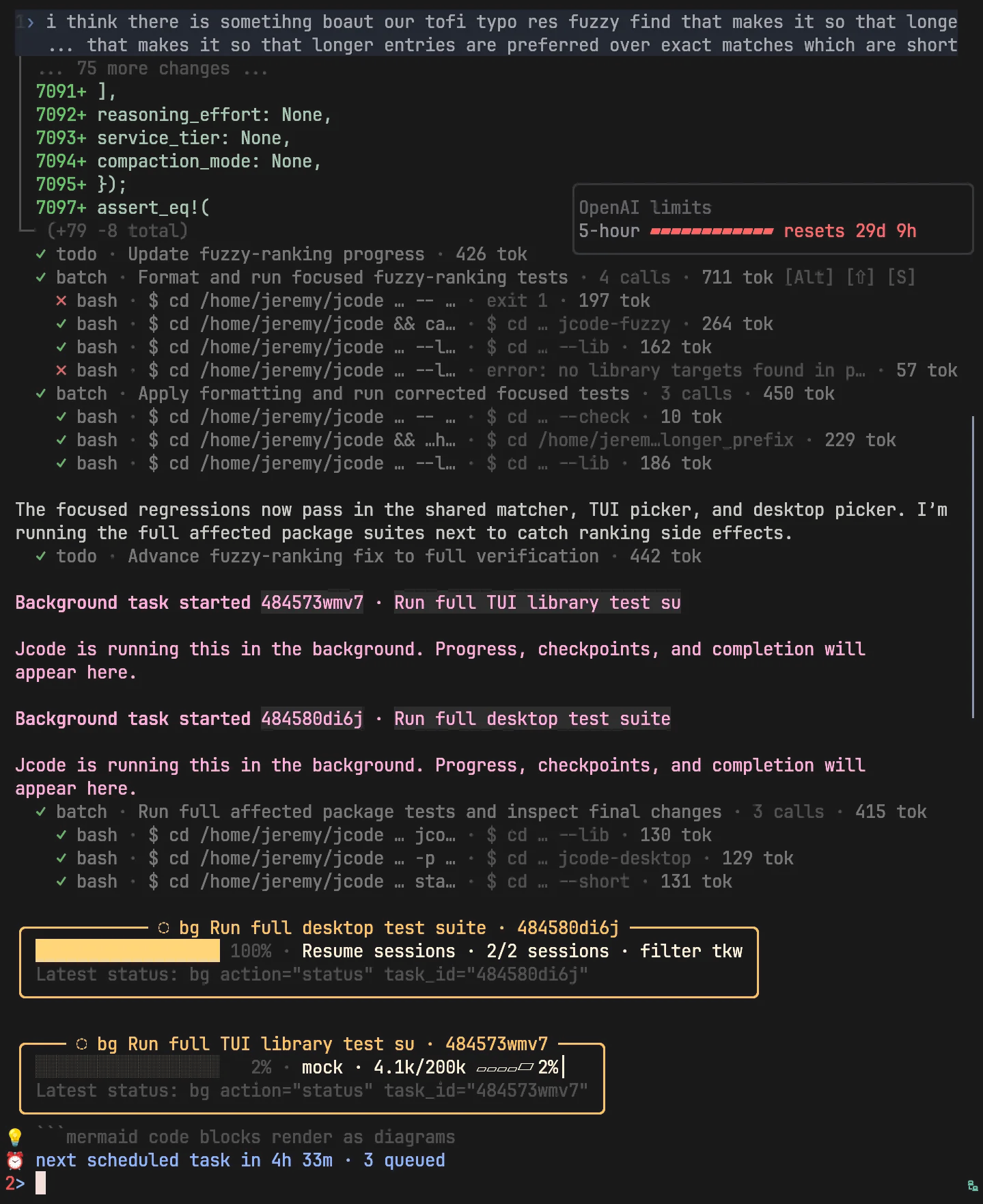
Ask the agent to run commands in the background, monitor progress cards, and wait on completions.
Optional: self-dev mode
Tell the agent to enter self-dev mode to modify its own source code and reload its binary.
Pros & Cons of jcode
Pros
- Extremely low memory overhead per additional session (~10.4 MB PSS vs ~212.7 MB for Claude Code).
- Very fast startup: ~14 ms to first frame and ~48.7 ms to first input.
- Built for massive parallelism: dozens of agents can run concurrently.
- MIT licensed and open source, with self-dev mode where the agent can modify its own source code.
- Prompt-cache-friendly architecture with append-only context and warm MCP tool schemas.
- Includes background task management, live progress cards, and memory system with semantic recall.
- Confidence stepping and auto-poke features reduce premature agent exits and improve task completion.
- Backed by Y Combinator.
Cons
- Benchmark comparisons are self-published by the project and may favor jcode.
- Ecosystem, third-party integrations, and community size are likely smaller than more established tools like Claude Code.
- Advanced features such as self-dev mode and custom benchmark methodology may have a learning curve.
- Designed for terminal users; not a GUI-first tool.
Frequently Asked Questions
What is jcode?
jcode is an open-source AI coding agent for the terminal, written in Rust, focused on running many agents in parallel with low resource usage.
Is jcode free?
Yes, jcode is MIT licensed and open source. You can install it with the provided curl command.
How does jcode compare to Claude Code?
jcode reports significantly lower memory overhead per additional session, faster startup time, and a smaller core prompt. It also emphasizes open-source customizability and parallel session execution.
Does jcode support MCP tools?
Yes, MCP tools are advertised from an on-disk schema cache at startup, with connections happening in the background and on-demand without breaking the prompt cache.
Can jcode work autonomously?
Yes, `jcode run` enables headless operation, and auto-poke continues work until todos are completed.
Pricing Overview
View full pricing →This is an open-source tool (MIT licensed). No pricing details are present in the provided content.
Detailed plans are not listed. Visit the official website for pricing information.
Reviews & Ratings0.0
No reviews yet. Be the first to write one!
Top Alternatives & Similar Software
View all alternatives & similar software→No alternatives available yet.
People also viewed

Related searches
Is this your tool?
Claim this page to update details, reply to user reviews, and drive more traffic to your product.
Claim this Product →
Tags
Explore Related Topics
Keep up with jcode alternatives
New alternatives, pricing changes and the week's biggest movers - one email every Tuesday.