


Deepnote vs Domino Data Lab
Side-by-side comparison of features, pricing, ratings, and alternatives.
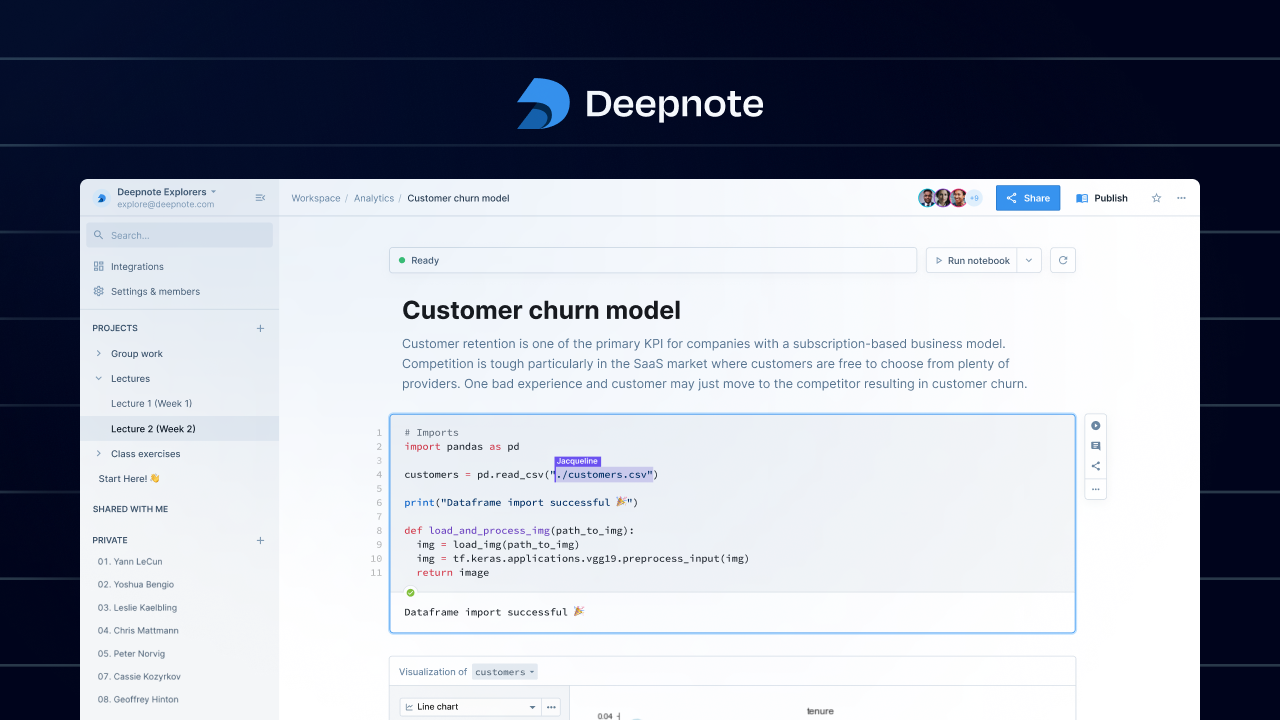
Deepnote is a cloud‑based notebook platform that lets multiple users write, run, and share Python and SQL code together in real time. It combines the familiar notebook experience with built‑in collaboration tools, version control, and instant visualizations. The platform integrates with popular data sources and version‑control systems, enabling teams to prototype, explore, and deploy analyses without leaving the browser. Deepnote’s focus on teamwork makes it ideal for data‑driven projects that require fast feedback and shared insights.
Domino Data Lab is a data science platform that enables data scientists to build, train, and deploy machine learning models efficiently. It provides a collaborative environment for data scientists to work together and share knowledge, accelerating the development of data-driven solutions.
- Instant collaborative editing eliminates version‑conflict headaches.
- Supports both Python and SQL in the same environment.
- Integrated visualizations and charts update live.
- Cloud‑only, no local installation required.
- Accelerates data science innovation
- Enables real-time collaboration and knowledge sharing
- Provides scalable and secure infrastructure
- Supports popular data science tools and frameworks
- Limited offline access; requires internet connection.
- Advanced enterprise features are behind paid plans.
- Not open source, so customization is constrained.
- May require significant upfront investment
- Can be complex to set up and configure
- Limited support for non-data science use cases
More alternatives & similar tools
Alternatives to Deepnote
View all →


Alternatives to Domino Data Lab
View all →


The Verdict
AI-generated from listing dataDeepnote is the safer default for teams that need low‑cost, real‑time notebook collaboration, while Domino suits enterprises needing scalable model deployment and broader data‑science tool support.
Key differences
- •Pricing model: Deepnote offers a freemium tier; Domino’s pricing is not disclosed.
- •Collaboration depth: Deepnote provides simultaneous editing and cell‑level comment threads; Domino’s real‑time features are less detailed.
- •Advanced ML capabilities: Domino includes automated model deployment, monitoring, and governance; Deepnote focuses on notebooks and visualizations.
- •Integration focus: Deepnote connects to GitHub, Slack, Google Drive, Snowflake; Domino integrates with AWS, GCP, Jupyter, RStudio, TensorFlow.
- •Target scale: Domino is built for large‑scale, secure infrastructure; Deepnote’s scalability details are not specified.
Pricing & value
Deepnote offers a freemium plan with known pricing; Domino’s cost is unknown, making Deepnote the clearer value.
Ease of use / learning curve
Deepnote’s instant collaborative editing and built‑in visualizations are straightforward; Domino may be complex to set up.
Features & depth
Domino provides automated model deployment, monitoring, and data‑governance, which Deepnote does not mention.
Integrations & ecosystem
Domino integrates with major cloud platforms (AWS, GCP) and ML frameworks (TensorFlow); Deepnote’s integrations are narrower.
Collaboration
Deepnote supports simultaneous multi‑user editing and cell‑level comment threads; Domino’s collaboration details are less specific.
Scalability
Domino explicitly offers scalable, secure infrastructure for large projects; Deepnote’s scalability is not specified.
Choose Deepnote if…
Teams needing low‑cost, real‑time notebook collaboration for Python/SQL analytics.
Choose Domino Data Lab if…
Enterprises requiring scalable model deployment, governance, and broad tool integrations.
Common questions
What is the cost to get started?
Deepnote has a freemium tier; Domino’s pricing is not disclosed in the provided facts.
Which platform supports real‑time collaborative editing?
Deepnote offers simultaneous notebook editing with cell‑level comments; Domino also supports collaboration but without detailed real‑time editing features.
Can I deploy and monitor machine‑learning models?
Domino includes automated model deployment and monitoring; Deepnote does not mention these capabilities.