


FFmpeg vs VideoProc Converter AI
Side-by-side comparison of features, pricing, ratings, and alternatives.
FFmpeg is a free, open-source software library for recording, converting, and streaming audio and video. It provides a wide range of features and tools for manipulating multimedia files, including support for various codecs, formats, and protocols.
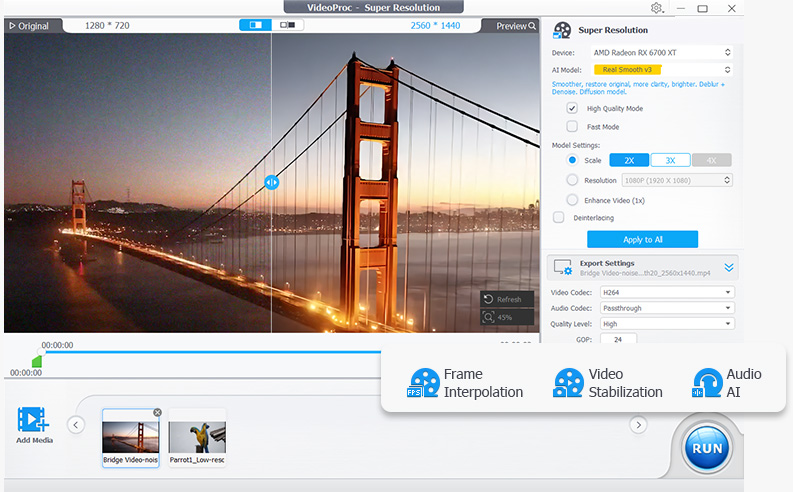
VideoProc Converter AI is an all-in-one video and image tool from Digiarty Software that combines format conversion with AI enhancement. It converts across 420+ output formats, uses AI super resolution to upscale low-resolution video up to 4K and images up to 8K, and applies frame interpolation, stabilization, and noise reduction to raw footage. The software also compresses files by more than 90 percent, includes screen and webcam recording, and downloads video from over 1,000 sites. Processing is accelerated through Level-3 hardware acceleration across NVIDIA, AMD, Intel, and Apple Silicon GPUs, aiming to make demanding AI tasks run at practical speeds on consumer hardware.
- Highly customizable and flexible
- Supports a wide range of codecs and formats
- Cross-platform compatibility
- Free and open-source
- Very broad format support for input and output
- GPU acceleration makes conversion significantly faster
- AI upscaling and stabilization go beyond basic conversion
- Lifetime license option avoids ongoing subscription cost
- Steep learning curve due to command-line interface
- Limited user interface and documentation
- May require additional software or libraries for certain features
- Free trial is limited by file size and duration restrictions
- Interface bundles many tools which can feel overwhelming for simple conversions
- AI enhancement features require capable GPU hardware for best speed
More alternatives & similar tools
Alternatives to FFmpeg
View all →
Alternatives to VideoProc Converter AI
View all →
Long-running video conversion tool supporting 1000+ formats with AI upscaling and compression.
The Verdict
AI-generated from listing dataVideoProc Converter AI offers a one‑time paid, GUI‑based tool with AI upscaling and GPU acceleration, while FFmpeg is free, open‑source, command‑line focused and highly customizable.
Key differences
- •Pricing model: one‑time purchase vs. free open‑source.
- •User interface: graphical desktop app vs. command‑line only.
- •AI‑enhancement features (upscaling, frame interpolation, stabilization) are built‑in for VideoProc but not in FFmpeg.
- •Hardware acceleration support: both claim it, but VideoProc emphasizes Level‑3 GPU acceleration for faster conversion.
- •Target audience: content creators needing simple UI vs. developers needing scriptable automation.
Pricing & value
FFmpeg is free and open‑source; VideoProc requires a paid one‑time license.
Ease of use / learning curve
VideoProc provides a desktop GUI; FFmpeg relies on a command‑line interface with a steep learning curve.
Features & depth
VideoProc includes AI upscaling, frame interpolation, stabilization, screen/webcam recording; FFmpeg lacks built‑in AI features.
Integrations & ecosystem
FFmpeg is open‑source, has API access, and integrates via scripts; VideoProc is a closed desktop app.
Support
FFmpeg offers email and documentation; VideoProc’s support details not specified.
Scalability
FFmpeg can be self‑hosted and scripted for batch processing; VideoProc is limited to a single desktop instance.
Security & privacy
FFmpeg is open‑source, allowing code review; VideoProc’s privacy practices not specified.
Choose FFmpeg if…
Developers or power users needing free, scriptable, cross‑platform processing with extensive codec support.
Choose VideoProc Converter AI if…
Content creators or casual users who prefer a GUI and AI video enhancements and can pay once.
Common questions
Is there any ongoing cost for VideoProc?
VideoProc offers a one‑time paid license; no subscription fees are mentioned.
Can I automate batch conversions with VideoProc?
Automation is not specified; VideoProc is a desktop app, whereas FFmpeg supports scripting via CLI.
Does FFmpeg provide AI upscaling like VideoProc?
No; AI upscaling, frame interpolation, and stabilization are listed only for VideoProc.