


ConceptMap vs MindMap AI
Side-by-side comparison of features, pricing, ratings, and alternatives.

A quiet tool for thinking that transforms PDFs, lecture notes, and ChatGPT conversations into dense, teachable mindmaps. Includes a Present mode to walk through nodes linearly.
MindMap AI is a web-based mind mapping platform that uses artificial intelligence to convert unstructured content into clear, organized visual maps. It accepts a wide range of inputs, including a simple idea, a PDF document, a YouTube video, or any web URL, and automatically extracts the key concepts to create a structured mind map. This makes it a flexible tool for turning raw information into actionable visuals quickly. The platform goes beyond basic diagramming by offering real-time collaboration, so teams can work on the same map together. Users can customize maps with notes, icons, media, links, connections, and tags, and choose from customizable themes to match their needs. Maps can also be shared via public links or exported as PDF, PNG, or JPEG files, making them easy to use in presentations and reports. MindMap AI is designed for anyone who needs to organize information efficiently, from students and researchers to professionals and teams. Its keyboard shortcuts and AI-driven workflow aim to reduce the time spent on manual structuring, allowing users to focus on thinking, learning, and decision-making. The product offers a free entry point without requiring a credit card, with a quick setup process and the option to cancel at any time.
- No signup required for 5 free maps
- AI extracts argument structure automatically
- Built-in Present mode for teaching and self-explanation
- Supports multiple languages natively
- AI-powered generation from multiple sources including ideas, PDFs, YouTube videos, and URLs
- Real-time team collaboration on mind maps
- Multiple export formats: PDF, PNG, and JPEG
- Keyboard shortcuts for faster workflow
- Only 5 free maps, likely paid beyond
- Limited to mindmap hierarchy, not propositional concept maps with cross-links
- No explicit offline functionality
- No offline mode is mentioned, so the AI-powered map creation likely requires an internet connection.
- Desktop and mobile apps are not mentioned; the product appears to be web-based only.
- Free plan limits, such as the number of maps or AI queries, are not disclosed.
- Complex or nuanced source material may need manual review and editing after AI processing.
More alternatives & similar tools
Alternatives to ConceptMap
View all →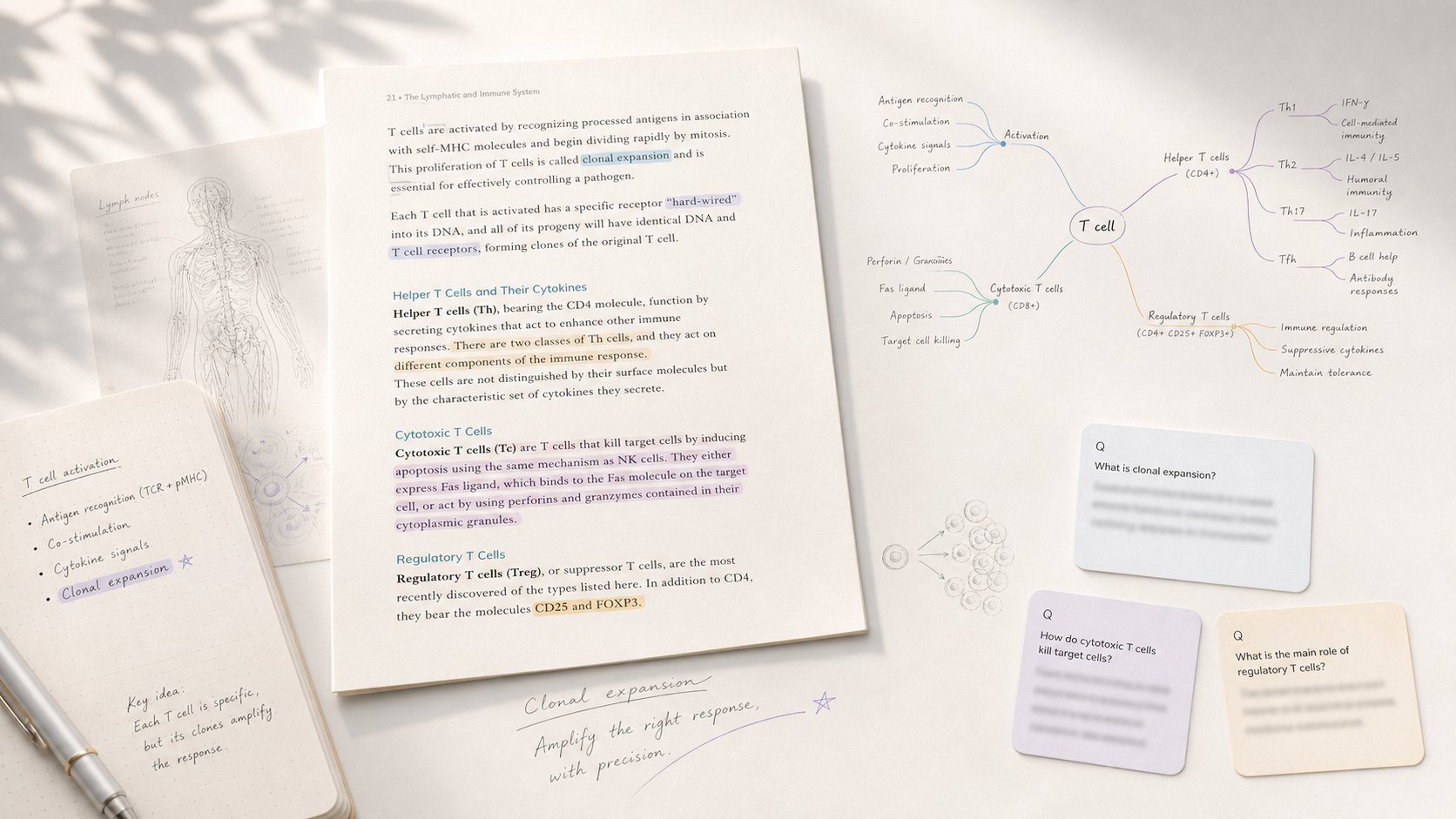
Study app that turns PDF/EPUB annotations into mind maps and spaced-repetition flashcards.

Alternatives to MindMap AI
View all →The Verdict
AI-generated from listing dataMindMap AI offers broader source input and real‑time team collaboration, while ConceptMap focuses on education‑oriented presentation features and multilingual support.
Key differences
- •Input sources: MindMap AI handles ideas, PDFs, YouTube videos, URLs; ConceptMap adds photos, ChatGPT chats, abstracts, lecture notes.
- •Collaboration: MindMap AI provides real‑time sharing and editing; ConceptMap only offers public view links and remix without live co‑editing.
- •Presentation mode: ConceptMap includes a built‑in node‑by‑node walkthrough; MindMap AI has no dedicated presentation feature.
- •Free‑tier limits: MindMap AI’s free plan details are unspecified; ConceptMap caps free maps at five.
- •Language support: ConceptMap natively supports ten languages; MindMap AI’s language capabilities are not specified.
Pricing & value
ConceptMap explicitly states a free tier of 5 maps; MindMap AI’s free limits are not disclosed.
Ease of use / learning curve
MindMap AI offers keyboard shortcuts and a 2‑minute setup; ConceptMap requires learning its presentation workflow.
Features & depth
MindMap AI extracts from multiple media types and offers extensive customization; ConceptMap is limited to hierarchical mindmaps.
Integrations & ecosystem
MindMap AI lists export to PDF/PNG/JPEG and public link sharing; ConceptMap’s integrations are limited to web sharing.
Collaboration
MindMap AI supports real‑time team editing; ConceptMap only provides static public links for viewing/remixing.
Scalability
MindMap AI’s web‑only model can scale with unlimited users; ConceptMap’s free tier caps at five maps.
Support, Security & privacy
Neither product provides specific information on support channels or security measures.
Choose ConceptMap if…
Educators or self‑learners who need multilingual, presentation‑ready maps and are okay with a small free quota.
Choose MindMap AI if…
Teams needing collaborative, multi‑source mind‑mapping without strict free‑map limits.
Common questions
Is there a free version and what are its limits?
ConceptMap offers 5 free maps; MindMap AI’s free plan exists but limits are not disclosed.
Can multiple users edit a map simultaneously?
Yes, MindMap AI provides real‑time collaboration; ConceptMap only allows public viewing/remixing, not live co‑editing.
What input types can each tool process?
MindMap AI accepts ideas, PDFs, YouTube videos, URLs; ConceptMap accepts PDFs, notes, photos, YouTube URLs, ChatGPT chats, abstracts, topics.