


Fivetran vs Hex
Side-by-side comparison of features, pricing, ratings, and alternatives.


Fivetran is a cloud‑based data integration platform that provides fully managed, zero‑maintenance pipelines to move data from hundreds of sources into cloud data warehouses. By handling extraction, loading, and schema management automatically, it lets analysts focus on insights rather than building and maintaining ETL code.
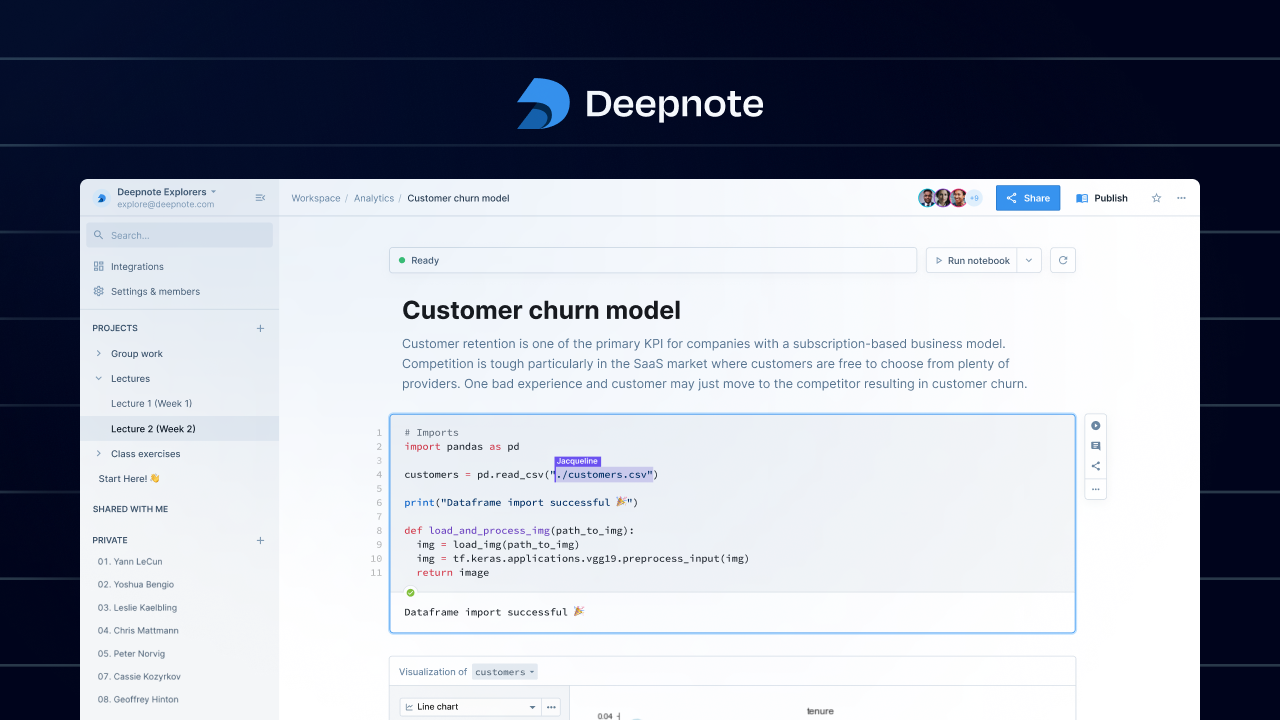
Hex is a cloud‑based data notebook that lets teams write SQL, Python, and R together in a single, shareable workspace. It combines powerful querying with visualizations, letting users turn raw data into interactive dashboards and data‑driven applications. Built for analysts, data engineers, and product teams, Hex integrates with modern data warehouses and supports version control, scheduling, and real‑time collaboration, making it easy to prototype, iterate, and ship data products without leaving the platform.
- No‑code setup with pre‑built connectors.
- Automatic schema evolution handling.
- Scalable architecture that grows with data volume.
- Extensive support for major cloud warehouses.
- Real‑time multi‑user collaboration
- Supports both SQL and Python/R in one environment
- Native integrations with major cloud warehouses
- Easy publishing of interactive dashboards
- Higher cost for large data volumes compared to DIY solutions.
- Limited transformation capabilities; relies on downstream tools.
- Primarily SaaS; no on‑premise deployment option.
- Limited offline or desktop client
- Advanced visual customization may require custom code
- Free tier has usage caps on compute
More alternatives & similar tools
Alternatives to Fivetran
View all →

Alternatives to Hex
View all →

The Verdict
AI-generated from listing dataFivetran delivers automated, scalable data pipelines with no‑code setup but at a higher subscription cost, while Hex offers a collaborative notebook environment for SQL/Python analytics at a freemium price with limited offline capability.
Key differences
- •Fivetran provides over 200 pre‑built SaaS connectors and automatic schema handling; Hex focuses on ad‑hoc SQL/Python notebooks.
- •Pricing model: Fivetran is paid subscription; Hex has a free tier with compute caps.
- •Collaboration: Hex supports real‑time multi‑user editing and cell‑level permissions; Fivetran lacks built‑in collaboration features.
- •Scalability: Fivetran’s architecture is built for high‑volume, continuous replication; Hex’s scalability is tied to notebook compute limits.
- •Transformation depth: Hex allows custom Python/R code within notebooks; Fivetran relies on downstream tools for transformations.
Pricing & value
Hex offers a freemium tier with no subscription fee, whereas Fivetran requires paid subscription.
Ease of use / learning curve
Fivetran’s no‑code connector setup is simpler than Hex’s notebook environment requiring SQL/Python knowledge.
Features & depth
Fivetran automates extraction, loading, and schema evolution; Hex provides analytics notebooks but limited built‑in ETL automation.
Integrations & ecosystem
Fivetran lists over 200 SaaS sources and major warehouses; Hex lists core warehouses plus GitHub/Slack only.
Collaboration
Hex includes real‑time multi‑user editing, comments, and version history; Fivetran has no collaboration layer.
Scalability
Fivetran’s cloud architecture scales with data volume; Hex’s scalability is limited by notebook compute caps.
Choose Fivetran if…
Enterprises needing reliable, high‑volume automated data ingestion and willing to pay for a managed service.
Choose Hex if…
Teams that prioritize collaborative analytics, mixed SQL/Python work, and low‑cost or free tooling.
Common questions
Can Hex replace a dedicated ETL tool like Fivetran?
Not fully; Hex can run ad‑hoc transformations but lacks automated, continuous data replication and schema management.
What are the cost implications for large data volumes?
Fivetran charges per volume and can become expensive; Hex’s free tier caps compute, and paid plans are usage‑based.
Do both platforms support Snowflake and BigQuery?
Yes, both list Snowflake and BigQuery as native integrations.