


VideoLingo vs VMEG AI Video Translator
Side-by-side comparison of features, pricing, ratings, and alternatives.

VideoLingo is an AI-powered video localization platform that generates cinema-grade bilingual subtitles and natural dubbing, aiming to connect audiences across language barriers frame by frame. Built for content creators, educators, and global teams, it goes beyond simple machine translation by adding cultural localization, domain-specific terminology handling, and polished single-line subtitles with precise timing. The platform is currently in Beta and offers a free trial covering up to 15 minutes of video. With a strong open-source community background, the project has earned more than 18,740 stars on GitHub and emphasizes continuous improvement and collaborative development. Its processing pipeline is designed for speed: users can upload content, choose target languages, and receive localized videos in just a few clicks. The service supports 8+ languages and is frequently praised by technical instructors, bloggers, and designers for accurately capturing jargon and preserving the original speaker's tone and intent. VideoLingo is especially valuable for technical content creators who need precise subtitle translations for programming tutorials, online courses, and professional training materials. The combination of cultural adaptation, domain expertise, and natural voice synthesis makes it a versatile tool for making knowledge accessible globally, without the stiff, robotic feel typical of automated translation and dubbing.
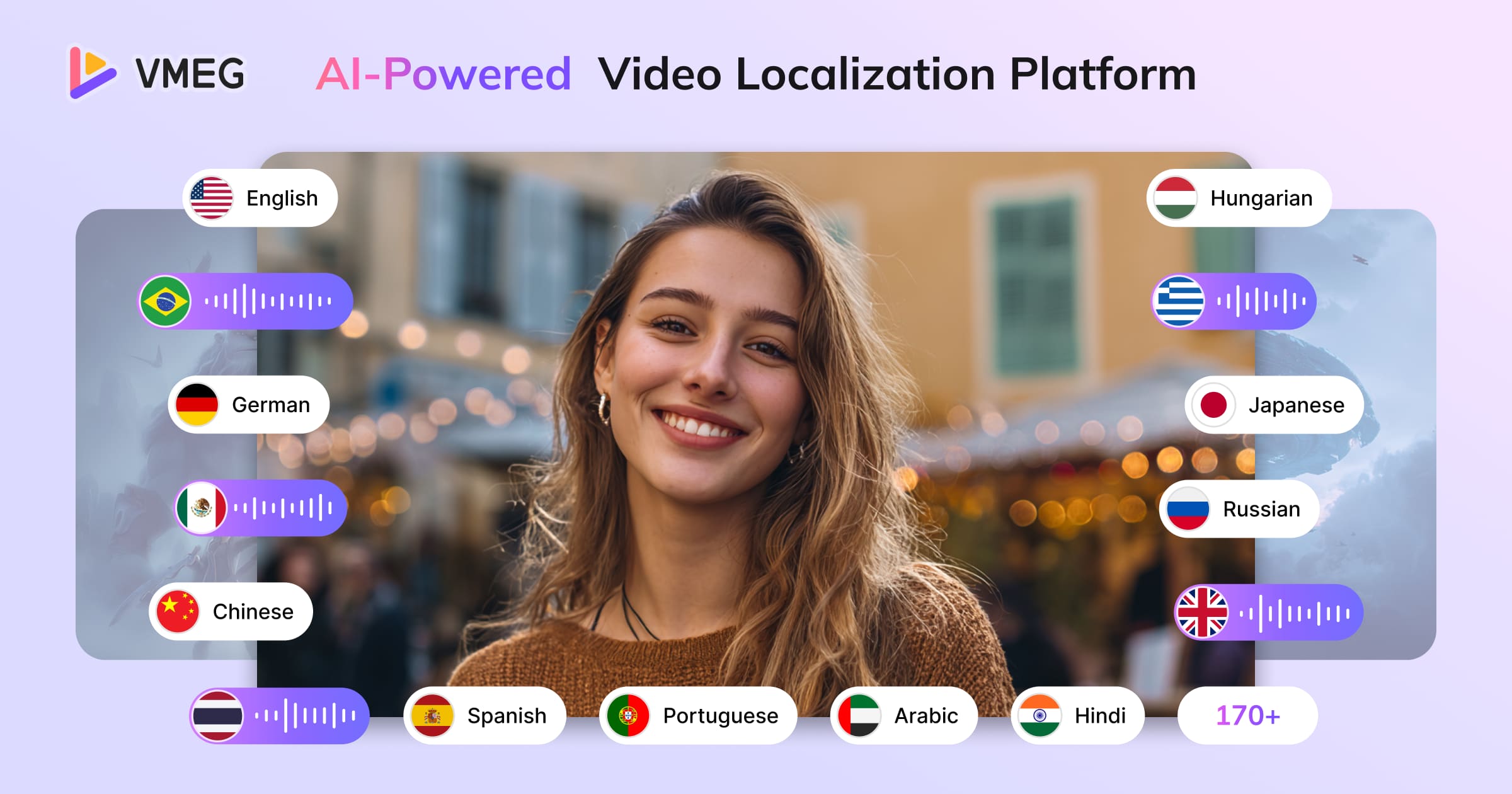
VMEG AI Video Translator is an online localization tool that turns videos in any supported format into multilingual content. It translates spoken content into 170+ languages and offers three main output options: a fully dubbed video, translated subtitles, or a separate audio track. Users can upload a file, paste a supported public video link, or pull an existing project from their workspace, making it flexible for creators, educators, and business teams. At the core of the tool is a studio-style dashboard where users can review translated scripts, edit text, adjust voice speed, volume, and tone, and assign voices per speaker. VMEG leverages 17,000+ AI voices and supports voice cloning to keep speakers recognizable across languages. It also detects multiple speakers in interviews, webinars, and conferences, while background music and non-speech audio can remain separate from the translated dialogue. Lip sync can be enabled to better match translated speech to the speaker's mouth movements. VMEG is positioned as a privacy-first, enterprise-ready platform. Customer data is encrypted using AES-256 at rest and TLS 1.3 in transit, isolated by workspace, and not used to train AI models by default. The tool also includes batch production and automation features, making it suitable for large-scale video localization workflows, global content distribution, and professional production standards.
VideoLingo offers a free tier with limited features plus paid subscription plans at $5 per month for Starter and $30 per month for Pro.
- Cinema-grade bilingual subtitles with accurate cultural localization
- Domain-specific terminology handling for technical content
- Natural voice synthesis preserves emotional tone and speaking style
- Fast, streamlined workflow requiring only a few clicks
- All-in-one localization workflow replaces separate transcription, translation, voiceover, and editing tools
- Supports 170+ languages and 17,000+ AI voices with flexible output formats
- Voice cloning and multi-speaker separation keep dialogue natural and recognizable
- Lip sync alignment makes dubbed videos look more polished and human-like
- Currently in Beta, so features and stability may evolve over time
- Free tier is limited to 15 minutes of video
- Only 8+ languages are supported, which may not cover all regions or dialects
- The homepage lacks detailed information about advanced editing or enterprise features
- Pricing, credits, and usage limits are not transparent until you sign in to your VMEG account
- Video length and file-size limits depend on your account and processing settings, which can restrict large projects
- Advanced features like lip sync and voice cloning may not be available in every workflow and require exploring the dashboard
- Public video links only work for supported sources and you must have permission to process the content
More alternatives & similar tools
Alternatives to VideoLingo
View all →
Translate your videos seamlessly in 140+ languages with natural voice clone and preserve authentic speaking styles.

One AI editor to localize any video or audio into 50+ languages through dubbing, translation, captions, and subtitles.
Translate videos into 170+ languages with AI voices, voice cloning, subtitles, and lip-synced dubbing—all in one online studio.
Alternatives to VMEG AI Video Translator
View all →
An AI subtitle generator that automatically transcribes and translates videos into captions in 76 languages in under 3 minutes.
AI-powered video translation and dubbing that clones your voice into 14+ languages.
Translate your videos seamlessly in 140+ languages with natural voice clone and preserve authentic speaking styles.
The Verdict
AI-generated from listing dataVMEG AI Video Translator offers a far broader language and voice library with enterprise‑grade security, while VideoLingo is a cheaper, open‑source‑backed option limited to a handful of languages and a free 15‑minute trial.
Key differences
- •Language & voice coverage: VMEG supports 170+ languages and 17,000+ AI voices vs. VideoLingo’s 8+ languages.
- •Pricing transparency: VMEG’s pricing and limits are undisclosed until sign‑in; VideoLingo has a clear freemium tier ($5/mo subscription).
- •Security: VMEG provides AES‑256 at rest and TLS 1.3 with data isolation; VideoLingo’s security details are not specified.
- •Advanced output: VMEG includes lip‑sync dubbing, multi‑speaker detection, and subtitle export formats; VideoLingo focuses on bilingual subtitles and basic dubbing.
- •Maturity: VMEG appears production‑ready; VideoLingo is still in beta with limited stability guarantees.
Pricing & value
VideoLingo offers a free tier (15 min) and a $5/mo plan; VMEG’s pricing and limits are not disclosed.
Ease of use / learning curve
VideoLingo advertises a few‑click workflow; VMEG’s many options (lip sync, voice cloning) may add complexity.
Features & depth
VMEG provides lip‑sync, voice cloning, multi‑speaker detection, 170+ languages, 17k voices; VideoLingo limited to 8+ languages and basic dubbing.
Integrations & ecosystem
VMEG supports multiple input methods (file, link, SRT) and output formats; VideoLingo’s integration details are not specified.
Security & privacy
VMEG uses AES‑256 encryption at rest, TLS 1.3 in transit, and workspace isolation; VideoLingo provides no security info.
Scalability
VMEG runs on AWS and targets enterprise workloads; VideoLingo is beta with unspecified scalability.
Support & community
VideoLingo has an open‑source community (18,740 GitHub stars); VMEG’s support details are not provided.
Choose VideoLingo if…
Small creators or educators on a tight budget who need quick bilingual subtitles for short videos.
Choose VMEG AI Video Translator if…
Enterprises or creators needing many languages, lip‑sync dubbing, and strong data security.
Common questions
How many languages can each tool translate?
VMEG supports 170+ languages; VideoLingo supports 8+ languages.
What are the costs to get started?
VideoLingo offers a free 15‑minute trial and $5/month plan; VMEG does not disclose pricing until you sign in.
Does either product provide enterprise‑grade security?
VMEG specifies AES‑256 at rest and TLS 1.3 in transit with isolated workspaces; VideoLingo’s security details are not specified.